
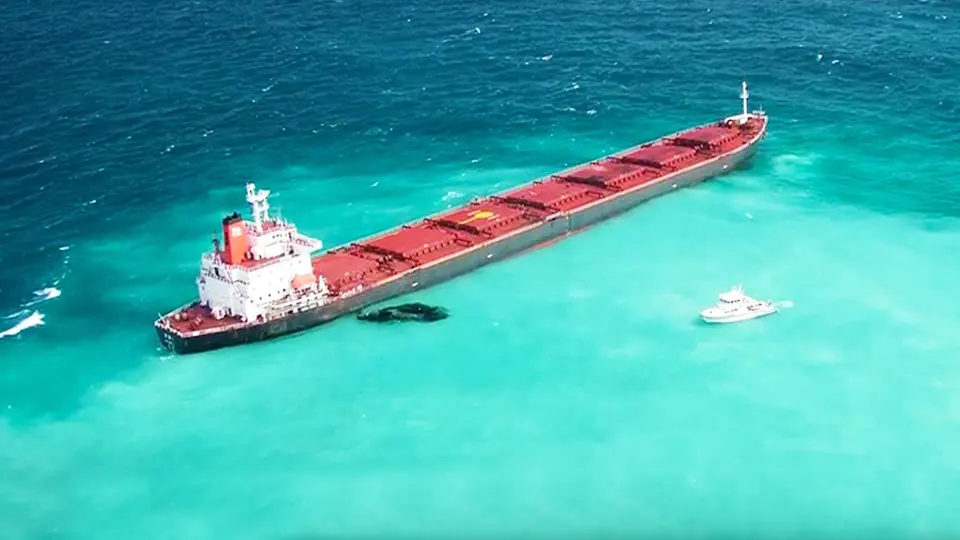
Douglas Shoal lies about 90 kilometres off Gladstone, well inside the Great Barrier Reef Marine Park. On 3 April 2010 the fully laden bulk coal carrier Shen Neng 1 steamed onto it at speed and stayed there for ten days before she could be refloated. The ship survived. The shoal did not come out of it well.
The hull had scraped across roughly 42 hectares of reef, crushing the hard structure into loose rubble and leaving long smears of antifouling paint ground into the seabed. It is the largest ship grounding scar known in the Marine Park, and quite possibly the largest anywhere.
A long road to a plan
In 2016 the Great Barrier Reef Marine Park Authority reached a settlement with the ship's owners and insurers worth $35 million, and the Douglas Shoal Remediation Project was born. What followed was years of careful assessment rather than quick action, because nobody had remediated a site like this before.
Survey teams sampled sediment across the shoal, towed video cameras along transects, mapped the rubble fields and worked out where the paint contamination was concentrated. Divers went in to ground-truth what the instruments showed. Out of 42 hectares, the priority areas were narrowed to about 10 hectares of channels, flat expanses, gullies and holes where loose rubble and contaminated sediment had collected.
Working on the shoal
Subsea was engaged on the project through this field work. For our crews it meant what reef work always means: long transits to an exposed site, weather windows that close without warning, and vessel, diving and survey support that has to be precise when the point of the exercise is to leave the reef in better condition than you found it.
In September 2023 the project moved to its main removal phase. A trailing suction hopper dredge, contracted from Boskalis Australia, lifted the rubble and contaminated sediment from the priority areas. Everything removed from the shoal was taken ashore and placed in ponds on land leased from Gladstone Ports Corporation, so that nothing was simply moved from one part of the reef to another.
Why it matters
The project's aim was never to rebuild the reef by hand. It was to take away the loose rubble and the paint so that the shoal can recover on its own, and to show that a remediation of this size can be done inside a World Heritage area without making things worse. Being part of that, even for one piece of a very long job, is work we are glad to have on our record.