
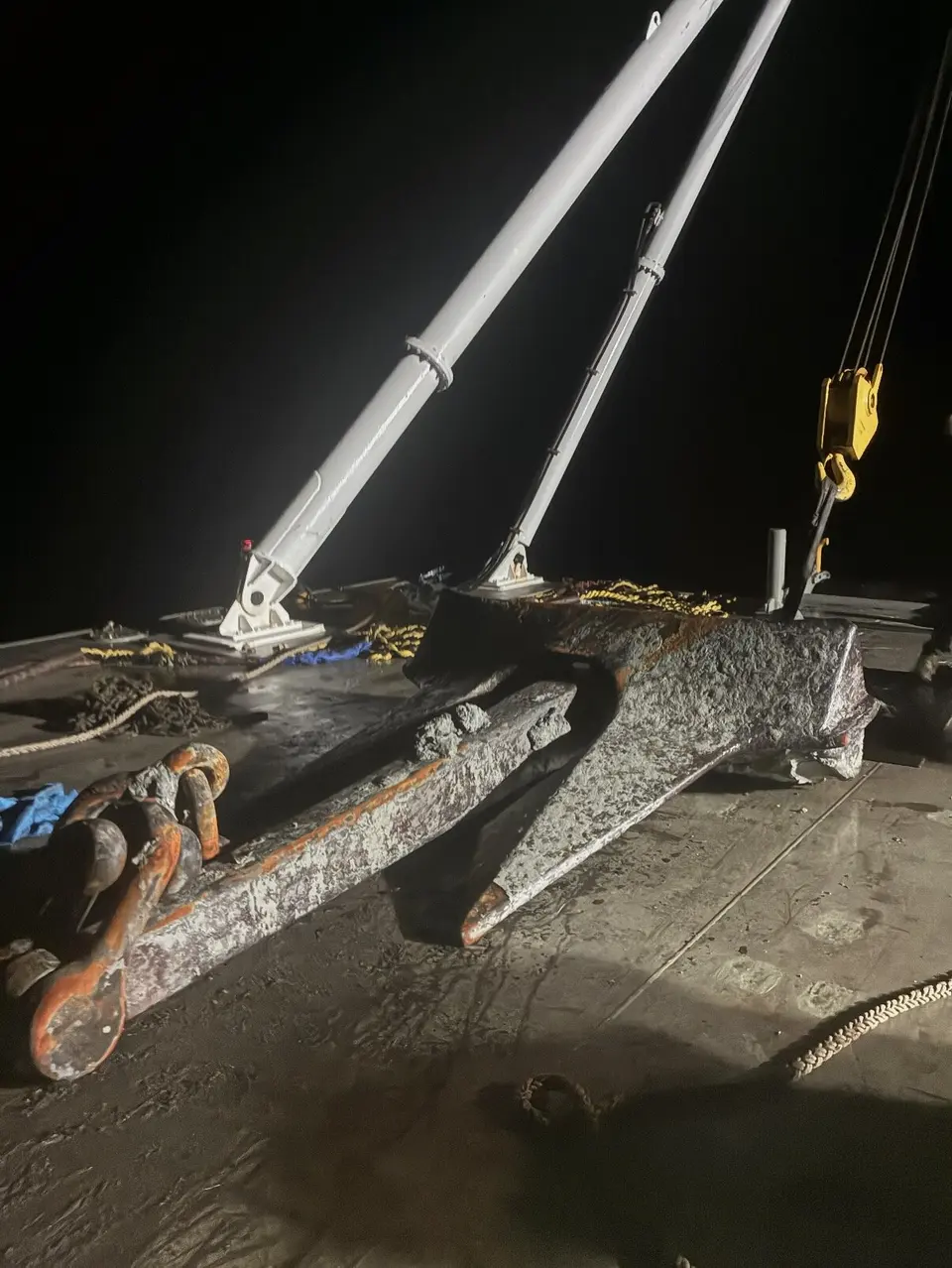
The coal anchorages off Mackay and Hay Point are among the busiest in the country, and big ships ride out some rough weather there. Every so often a chain parts, or a brake lets go, and an anchor goes to the bottom. Replacing one is not just the price of the steel. The ship is off-hire until a replacement arrives, and that can cost more than the anchor itself.
So when a shipowner asked us to find and recover a lost anchor worth about $250,000, the economics were simple. The search was not.
Why it is hard
The ship's log gives a position, but a vessel swinging at anchor in a blow can be a long way from where it thinks it is, and the anchor may have dragged before the chain gave way. What you are left with is a search box several kilometres across, a seabed that is mostly featureless sand and mud, and an object that, for all its weight, presents a surprisingly small target. Hence the phrase everyone reaches for: a needle in a haystack.
How we found it
Once the approvals were in place, we put a side-scan sonar towfish in the water and started mowing the lawn: long parallel lines, tight overlap, no gaps. Every hard return gets logged and graded. The good ones get a second pass from a different direction, because a real anchor throws a very particular shadow. The best ones get a diver.
Weather took its share of the calendar. In the end the search ran to about two months from approval to confirmation, with the anchor found, as they usually are, somewhere nobody had bet on.
Bringing it up
Recovery is the part we are most comfortable with. Divers rigged the anchor and its chain, lift bags floated it clear of the bottom, and a tug brought it back to Mackay Harbour where a crane lifted it onto the wharf for inspection and return to the ship.
Not every anchor goes home. One of the large ship anchors Subsea has recovered from this coast now stands on a roundabout at Mackay Harbour. If you have driven past it, you have seen the end of a story very much like this one.